PROM-FRAGILE (2022-ongoing)
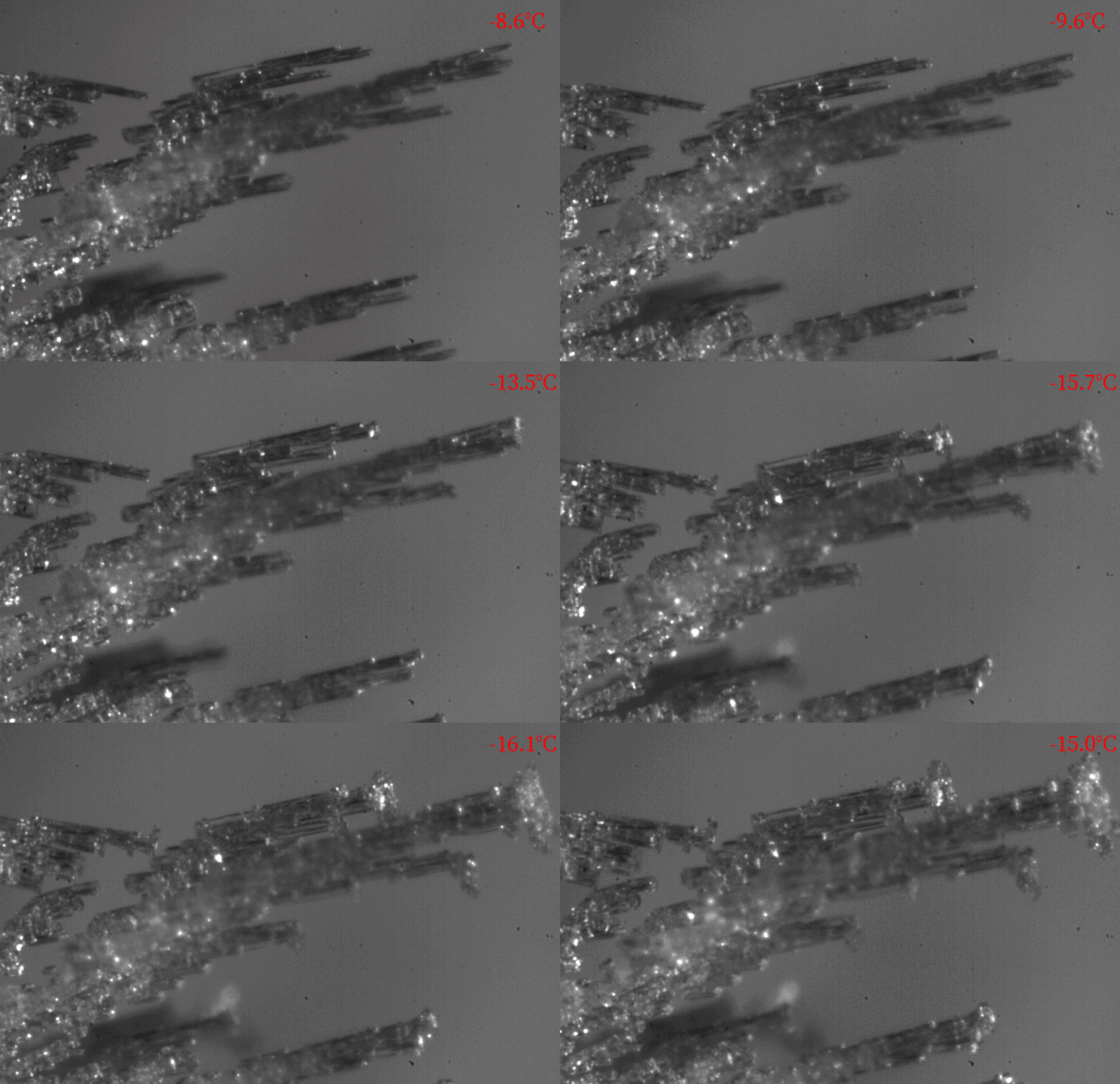
Description
Building on the findings of the PROM-IMPRINT project, the causes behind the observed increase in ice particle concentration within the dendritic growth layer are being further investigated. In a new study, the McSnow model was employed to explore which microphysical processes might contribute to this increase. Incorporating recent laboratory results from Grzegorczyk et al. 2023, a new collisional fragmentation scheme was implemented in McSnow.
To enable direct comparison between the McSnow simulations and radar observations, a comprehensive scattering database was created using the discrete dipole approximation (DDA). This database includes the scattering properties of 3,100 ice particles and serves as the foundation for a newly developed radar forward operator.
The simulations revealed that the observed increase in differential reflectivity (ZDR) within the dendritic growth layer can only be reproduced if ice crystals are nucleated locally around -15°C. This finding challenges earlier hypotheses suggesting that sedimenting ice particles entering this temperature region are responsible for the radar signatures. Moreover, the simulations demonstrated that a secondary ice production process is required to locally enhance the ice particle number concentration and to explain the observed increase in specific differential phase (KDP). Ice–ice collisional fragmentation emerges as a likely candidate for this secondary process.
These findings will be presented in two upcoming publications.